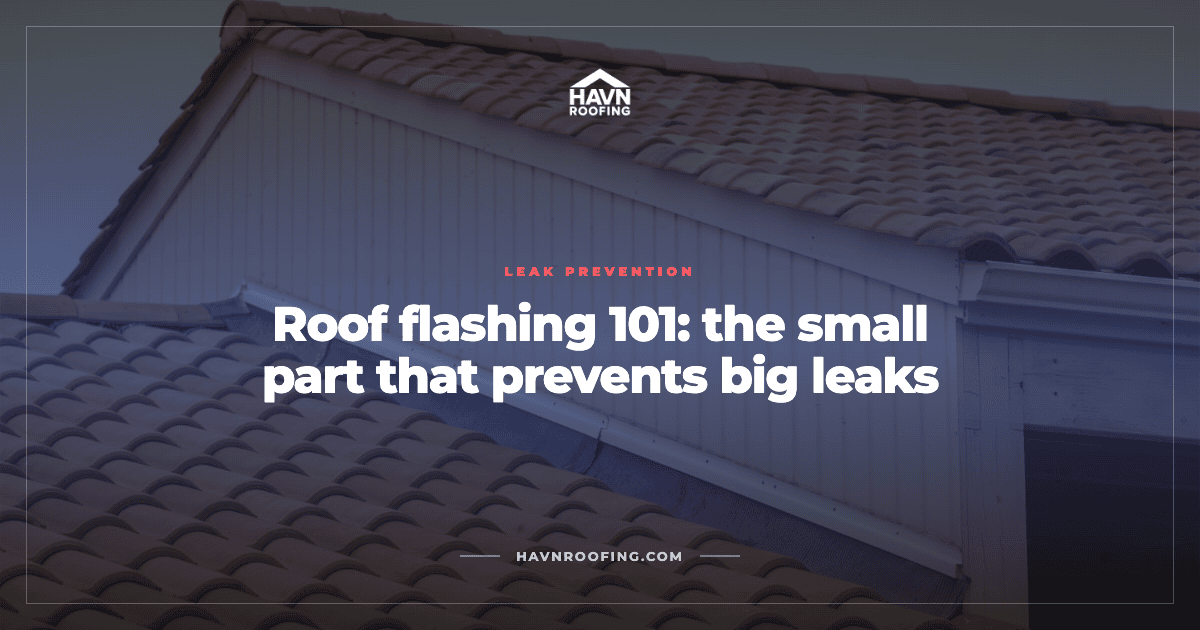
Roof Flashing 101: The Small Part That Prevents Big Leaks
Roof flashing is easy to overlook, but it’s one of the most common sources of leaks. Here is what flashing does, where it’s used, and why it fails.
When homeowners think about their roof, they usually picture the shingles or tile on top — not the thin strips of metal tucked around chimneys, vents, and valleys. But flashing is one of the most important components on your entire roof, and it is also one of the most common places leaks actually start. Here is what it is, where it shows up, and why such a small detail causes such big problems when it fails.
What is roof flashing?
Flashing is a thin, weatherproof material — usually metal like galvanized steel, aluminum, or copper — installed at the points on a roof where water is most likely to find a way in. Those are typically places where the roof surface meets something else: a chimney, a vent pipe, a skylight, a wall, or where two roof slopes come together to form a valley.
Shingles and tile are good at shedding water on a flat, continuous slope. They are not designed to seal around an object poking through the roof or a joint where two surfaces meet at an angle. That is the job flashing exists to do — it bridges those gaps and directs water safely down and off the roof instead of letting it seep underneath the roofing material.
Why flashing matters more than its size suggests
Flashing typically makes up a small fraction of a roof’s total surface area, but it is disproportionately responsible for leaks. Roofing material covers broad, uninterrupted surfaces reasonably well on its own. It is the transitions and penetrations — the joints, seams, and edges — where water pressure concentrates and where a small gap or a piece of corroded metal can let water through. Industry experience consistently points to flashing failures, not worn-out shingles or tile, as one of the leading causes of roof leaks.
Common types of roof flashing
Chimney flashing
Chimneys require some of the most involved flashing work on a roof. A properly flashed chimney typically combines base flashing at the bottom, step flashing running up the sides, and a cap or counter-flashing mortared into the brick to lap over everything else. Each piece protects a different part of the joint, and a failure in any one of them can let water in.
Valley flashing
A roof valley is where two sloped sections of roof meet, forming a channel that collects and funnels a large volume of water during rain. Valley flashing lines that channel and directs water down and off the roof rather than letting it work its way under the shingles or tile on either side. Given how much water passes through a valley during a storm, this is one of the highest-stakes flashing applications on the roof.
Step flashing
Step flashing is used along the sides of chimneys, dormers, and other vertical walls that meet a sloped roof. Individual L-shaped pieces are layered with each course of shingles as they go up the roof, creating a stepped, overlapping seal that sheds water down and away from the wall.
Vent and pipe flashing
Roofs almost always have plumbing vent pipes, exhaust vents, or other small penetrations passing through them. Vent flashing — often called a boot — wraps around the base of the pipe and seals against the surrounding roofing material. The rubber gasket component of many vent boots is also one of the more common points of failure over time, since rubber degrades with age and UV exposure.
Drip edge
Installed along the eaves and rakes of the roof, drip edge flashing directs water away from the fascia board and prevents it from wicking back underneath the roofing material at the roof’s edges — a detail that protects both the roof deck and the fascia and gutters below it.
Wall and headwall flashing
Where a roof meets a vertical wall — such as where a lower roof section runs into a second-story wall — wall flashing extends up and behind the exterior wall covering, directing water down and out onto the roof surface below rather than behind the siding or stucco.
Why flashing fails
Flashing does not typically fail all at once. Metal flashing can corrode over time, especially at seams or fastener points. Sealant and caulking used alongside flashing dries out and cracks under UV exposure and thermal cycling. Flashing can also become loose or bent from wind, impact, or simply age, and rubber components like vent boots deteriorate faster than the metal around them. In many cases, flashing failures develop slowly and go unnoticed until water damage shows up inside the home — a stained ceiling, a damp patch in the attic, or a musty smell that indicates moisture has been getting in for a while.
Signs your flashing may be failing
- Water stains on ceilings or walls, particularly near a chimney or where an interior wall lines up with the roofline
- Visible rust, corrosion, or lifted edges on metal flashing during a roof inspection
- Cracked or missing sealant around vent pipes, skylights, or chimney bases
- Daylight visible through gaps around roof penetrations from inside the attic
- Granule buildup or debris collecting specifically around flashing points, which can be a sign shingles nearby are being disturbed
Why flashing needs a professional eye
Flashing failures are often subtle and easy to miss during a casual glance at the roof from the ground. They also require the right materials and installation technique for the specific application — chimney flashing, for example, needs to be properly integrated with the masonry, not just caulked on top of it. A roof inspection that specifically checks flashing at chimneys, valleys, vents, and wall intersections is one of the most valuable things a homeowner can have done, whether as routine maintenance or after a storm.
FAQs
Can roof flashing be repaired without replacing the whole roof?
In most cases, yes. Flashing issues are often isolated to a specific area — a chimney, a valley, or a vent — and can be repaired or replaced without a full roof replacement, provided the surrounding roofing material is still in good condition.
How long does roof flashing last?
Metal flashing itself can last as long as the roof, but the sealants and rubber components paired with it typically need attention sooner — often within 10 to 15 years — since they degrade faster than the metal.
Is flashing more likely to fail after a storm?
Yes. Wind can lift or bend flashing, and heavy rain puts extra pressure on any existing gaps or weak points, which is why a post-storm inspection often turns up flashing issues that were not obvious before.
Do all roof leaks trace back to flashing?
Not all, but flashing is one of the most common sources, particularly around chimneys, valleys, and roof penetrations. A thorough inspection can help pinpoint whether flashing or another part of the roof is the actual source of a leak.
Have more questions? Check out our FAQ page.