Why HAVN Roofing Offers a Free Inspection — and What We Actually Check
A free inspection sounds like a sales tactic. We understand the skepticism. Here is what we actually do when we get on your roof, and why it matters to you as a homeowner.
Scottsdale
Tempe
Mesa
Chandler
Gilbert
Free inspections are common in the roofing industry — which is exactly why homeowners are right to wonder what is actually going on when a contractor offers one. Is it a diagnostic service, or just a way to get someone on your roof and pitch you a replacement?
At HAVN Roofing, we offer free inspections for a straightforward reason: most homeowners in the Phoenix area do not know the true condition of their roof, and that uncertainty costs them money — either through missed repairs that turn into larger problems, or through unnecessary replacements they did not actually need. A real inspection changes that. Here is exactly what ours involves.
Why we do it for free
The honest answer is that a transparent inspection builds trust in a way that nothing else does. When a homeowner can see exactly what we found — documented with photos and explained clearly — they can make an informed decision without pressure. That is good for them, and it is good for us.
Roofing is a significant investment. Nobody should feel rushed or confused when deciding whether to repair or replace their roof. Our inspection gives you real information upfront so that any conversation about next steps starts from a position of clarity, not uncertainty.
We also recognize that Arizona’s climate is unusually hard on roofs. Phoenix, Scottsdale, Chandler, Mesa, Gilbert, and Tempe homeowners deal with intense UV exposure, sustained triple-digit heat, and monsoon-season wind and rain — often all within the same year. That combination creates specific failure patterns that are worth catching early.
What we check on the roof surface
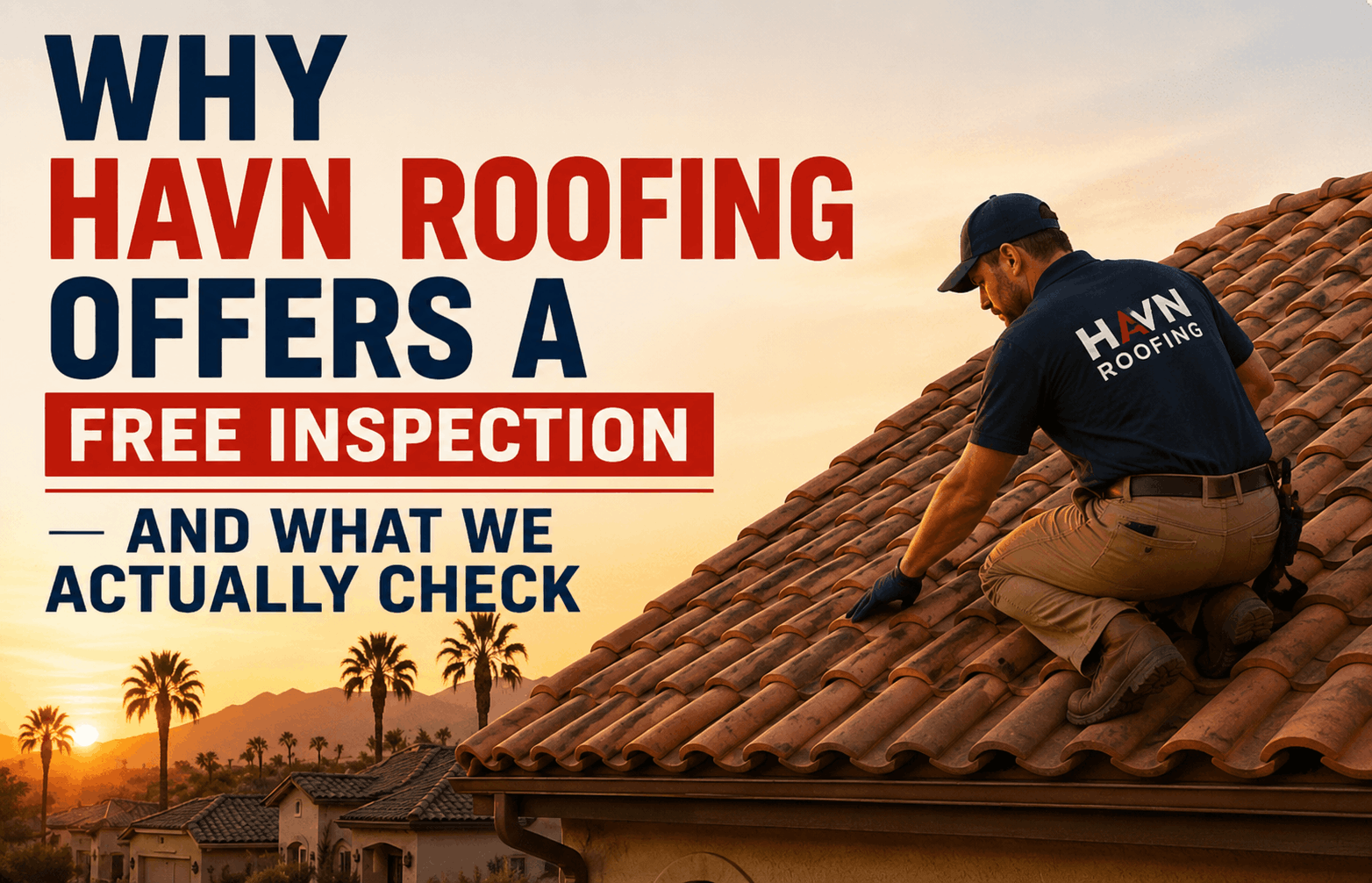
Our inspector goes onto the roof — not just around it. A visual inspection from the ground misses too much. Here is what we look at once we are up there.
Shingle or tile condition
For shingle roofs, we look for cracking, blistering, curling, and granule loss. These are the most direct signs of UV and heat degradation, which accelerates in Arizona compared to cooler climates. Missing or lifted shingles are also flagged, particularly after monsoon season. For tile roofs, we check for cracked, slipped, or missing tiles — because even one compromised tile can allow water under the system when the next storm hits.
Flashing integrity
Flashing — the metal strips that seal transitions around chimneys, vents, skylights, and roof edges — is one of the most common sources of leaks. We inspect every flashing point for lifting, corrosion, gaps, and improper sealing. This is an area that often gets overlooked on newer roofs but causes real damage when it fails.
Ridge and hip condition
The ridge and hip caps take more wind exposure than any other part of the roof. In Arizona, monsoon-season winds frequently loosen or dislodge these components. We check that they are fully sealed and secured.
Penetrations and boots
Every pipe boot, vent cap, and roof penetration is a potential entry point for water. We check the condition of the rubber boots around pipe penetrations specifically — these degrade faster in UV-heavy climates and are a frequent source of slow leaks that go undetected for months.
What we check in your attic
A roof system includes more than the exterior surface. When accessible, we also inspect the attic — because what is happening up there directly affects how your roof performs and how long it lasts.
Ventilation
Poor attic ventilation is one of the leading causes of premature roof failure in Arizona. When heat builds up in an under-ventilated attic — and in summer, that can mean temperatures well above 150°F — it accelerates the breakdown of roofing materials from below. We check that intake and exhaust ventilation are balanced and functioning.
Signs of water intrusion
Staining, soft decking, and mold growth in the attic are signs that water has already gotten in — sometimes from a source the homeowner was not aware of. Catching this early can prevent significant structural damage down the line.
Decking condition
The roof deck is the foundation everything else sits on. We check for soft spots, delamination, and any areas that may need reinforcement before a repair or replacement is done correctly.
What you get after the inspection
After we complete the inspection, we put together a clear summary of what we found — including photos of any problem areas and an honest assessment of your roof’s overall condition. We do not just hand you a quote and wait. We walk through the findings with you so you understand what you are looking at.
If your roof is in good shape, we will tell you that. If there are repairs worth doing now to extend the life of your system, we will explain what they are and why they matter. If we believe your roof is approaching the end of its useful life, we will say so — and we will explain the reasoning so you can make the call that is right for your home and your budget.
There is no obligation to move forward with HAVN after the inspection. Our goal is to give you information you can actually use.
What to expect on the day of your inspection
- Our inspector arrives within the scheduled window and introduces themselves before going onto the roof.
- The inspection typically takes 30 to 60 minutes depending on the size and complexity of your roof.
- We photograph any areas of concern as we go so you can see exactly what we saw.
- After the inspection, we walk through the findings with you on-site or follow up with a written summary — whichever works better for you.
- If you have questions about what we found, we answer them directly. No pressure, no upsell script.
When is the right time to schedule an inspection?
You do not need to wait until you see a stain on the ceiling to get your roof looked at. In Arizona specifically, there are a few moments where an inspection is especially worthwhile.
Before monsoon season. The window between late May and early July is a smart time to confirm your roof is ready for the rain and wind that monsoon season brings. Any weak points — cracked tiles, lifted shingles, failing pipe boots — are much cheaper to address before a storm than after.
After a significant storm. High winds and hail can cause damage that is not visible from the ground. If your neighborhood took a storm, an inspection confirms whether your roof came through cleanly or needs attention.
When buying or selling a home. Roof condition is one of the most consequential factors in a home transaction. An independent inspection gives buyers confidence and gives sellers the opportunity to address issues before they become negotiating points.
If your roof is 10 or more years old. At this age, most Arizona roofs have experienced enough thermal cycling and UV exposure to warrant a closer look — even if there are no visible signs of trouble yet.
The bottom line
We offer free inspections because we believe homeowners deserve an honest picture of what is going on with their roof before they spend any money. Arizona’s climate is demanding, and a roof problem left unaddressed tends to get more expensive over time — not less.
If you are curious about your roof’s condition — or just want a professional set of eyes on it before monsoon season — we are happy to come out. No obligation, no pressure. Just a straight answer about what we find.