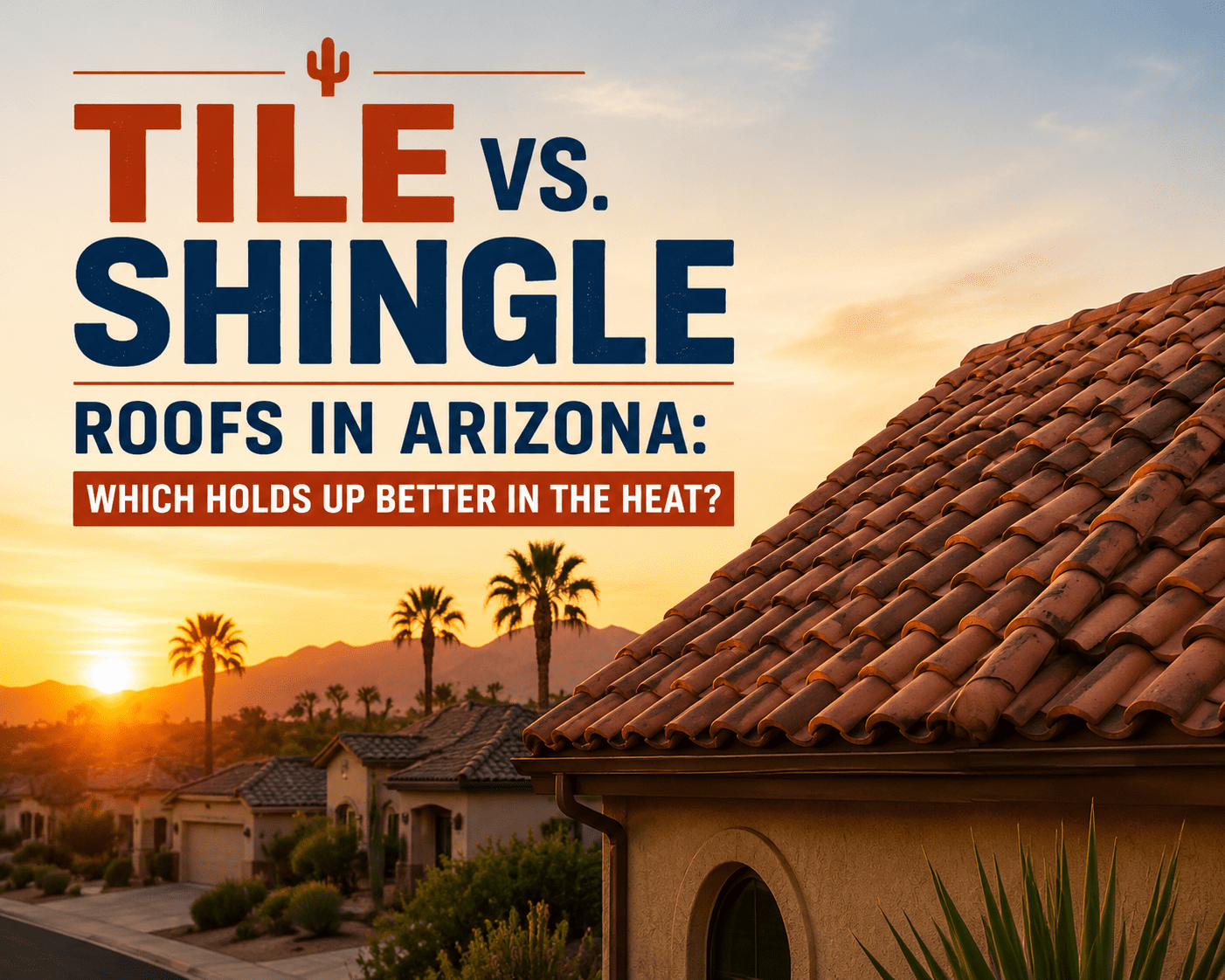
Tile vs. Shingle Roofs in Arizona: Which Holds Up Better in the Heat?
Both options can work in Arizona — but they perform differently under extreme heat, UV exposure, and monsoon stress. Here is what homeowners in the Phoenix area should know before choosing.
Scottsdale
Tempe
Mesa
Chandler
Gilbert
If you are comparing roofing options for a home in Arizona — or trying to understand why your neighbor has tile and you have shingles — the heat question comes up fast. Arizona is one of the harshest climates in the country for roofing materials. Triple-digit summers, intense UV exposure, dry heat followed by monsoon storms, and dramatic temperature swings all put stress on your roof in ways that most of the country never experiences.
So which holds up better: tile or shingles? The honest answer depends on what you are optimizing for.
How Arizona’s climate affects roofing materials
Before comparing the two, it helps to understand what your roof is actually up against here in the Phoenix area. Arizona roofs deal with sustained extreme heat — surface temperatures can exceed 170°F in summer — along with intense UV radiation, dramatic thermal cycling between day and night, and the concentrated stress of monsoon season between June and September.
Any roofing material installed in Gilbert, Chandler, Scottsdale, Tempe, or elsewhere in the Valley is going to face all of these conditions. The question is how each material responds to them over time.
Tile roofs in Arizona: what to know
Tile — whether concrete tile or clay tile — is the most common roofing material in the Phoenix metro area, and for good reason. It is well-suited to the Arizona climate in several important ways.
Durability and lifespan
A properly installed tile roof in Arizona can last 40 to 50 years or longer. The tile itself is extremely resistant to UV degradation and heat, which is a significant advantage in a climate where sun exposure is relentless.
How tile handles Arizona heat
Tile has natural thermal mass, meaning it absorbs heat slowly and releases it slowly. Many tile profiles also allow air to circulate underneath the tile surface, which can reduce how much heat transfers directly into the attic — a meaningful characteristic in Arizona’s climate.
What tile does not handle as well
Tile is heavy. Not every home structure is built to support a full tile roof without reinforcement. Tile is also more expensive upfront than asphalt shingles, and individual tiles can crack under impact. Cracked tiles need to be replaced promptly, because the underlayment beneath them is what actually keeps water out.
Tile in monsoon season
Tile holds up well in wind and rain when it is in good condition. The risk during monsoon season is typically cracked or slipped tiles that were already compromised — those become entry points for water during storms.
Shingle roofs in Arizona: what to know
Asphalt shingles are the most common roofing material in the United States, but Arizona is genuinely one of the harder climates for them. That does not mean shingles are a bad choice here — it means product selection and installation quality matter more than in a milder climate.
Durability and lifespan in Arizona heat
Standard 3-tab shingles typically last 15 to 20 years in Arizona. Architectural (dimensional) shingles generally last 20 to 30 years. In both cases, lifespan is shorter than tile — largely because asphalt degrades faster under intense UV exposure and thermal cycling. High-quality shingles with Class 4 impact ratings and reflective granules perform meaningfully better in Arizona conditions.
How shingles handle Arizona heat
Asphalt is more vulnerable to heat than tile. In extreme heat, low-quality shingles can blister, curl, or crack. The granules on the surface — which protect the asphalt from UV — can loosen over time, accelerating wear. Choosing the right shingle product for Arizona conditions matters significantly.
Where shingles have advantages
Shingles cost less upfront and are easier and faster to install and repair. They are lighter, so there are no structural concerns. For homeowners on a tighter budget, or where a full tile roof is not practical, a quality architectural shingle is a reasonable option for Arizona — especially when installed with good underlayment and proper attic ventilation.
Shingles in monsoon season
Well-installed shingles handle rain effectively. The greater monsoon risk for shingle roofs is wind — high winds can lift or tear shingles, especially on older roofs or where installation was not done correctly. Any loose or damaged shingles going into monsoon season are worth addressing beforehand.
Side-by-side comparison
| Tile | Shingles | |
|---|---|---|
| Lifespan in Arizona | 40–50+ years | 20–30 years (architectural) |
| Heat resistance | Excellent | Moderate (product-dependent) |
| UV resistance | Excellent | Moderate |
| Upfront cost | Higher | Lower |
| Weight | Heavy | Light |
| Monsoon performance | Strong (if intact) | Good (wind is the main risk) |
| Repair complexity | Moderate | Easy |
Which is the better choice for your Arizona home?
There is no single right answer. Here is how to think about it.
Tile is likely the better long-term choice if your home’s structure can support it, you plan to stay in the home for many years, and you want a roofing system that requires less frequent replacement.
Shingles may be the more practical choice if upfront cost is a significant factor, your home is not built for tile, or you are replacing a shingle roof and want a quality upgrade without the full investment of a tile system.
In both cases, product quality and installation matter as much as the material category. A well-installed architectural shingle roof with quality underlayment will outperform a poorly installed tile roof every time.
Smart questions to ask before choosing a roof in Arizona
- Is my home’s structure built to support tile, or would it need reinforcement?
- What shingle products are rated for high-UV and high-heat climates?
- How does my attic ventilation factor into how either option performs?
- What does the warranty cover, and how does it apply in Arizona’s climate?
- Which option makes more sense given my budget and how long I plan to stay in the home?
These questions are worth asking any roofing contractor you speak with in the Phoenix area, whether you are in Mesa, Queen Creek, Gilbert, Scottsdale, or anywhere else in the Valley.
Final takeaway
Both tile and shingles can perform well in Arizona when the right product is chosen and installation is done correctly. Tile has the edge on longevity and heat resistance. Shingles offer lower upfront cost and simpler repairs. Neither is the wrong answer — but the details of what you choose and who installs it matter a great deal in a climate as demanding as ours.