How Spray Foam Roofing Works — And Why It’s Popular in the Valley
Spray foam roofing shows up on a lot of Phoenix-area homes, especially flat and low-slope sections. Here’s how it actually works and why it fits Arizona so well.
If you’ve had a roofer mention “spray foam” for a flat or low-slope section of your home — a patio extension, a casita, an older ranch-style addition — you’re not alone. Spray polyurethane foam, usually called SPF, is one of the most common roofing systems on flat and low-slope sections across the Phoenix area. It looks and behaves very differently from tile or shingles, so here’s a straightforward explanation of how it works and why it’s such a fit for the Valley.
What spray foam roofing actually is
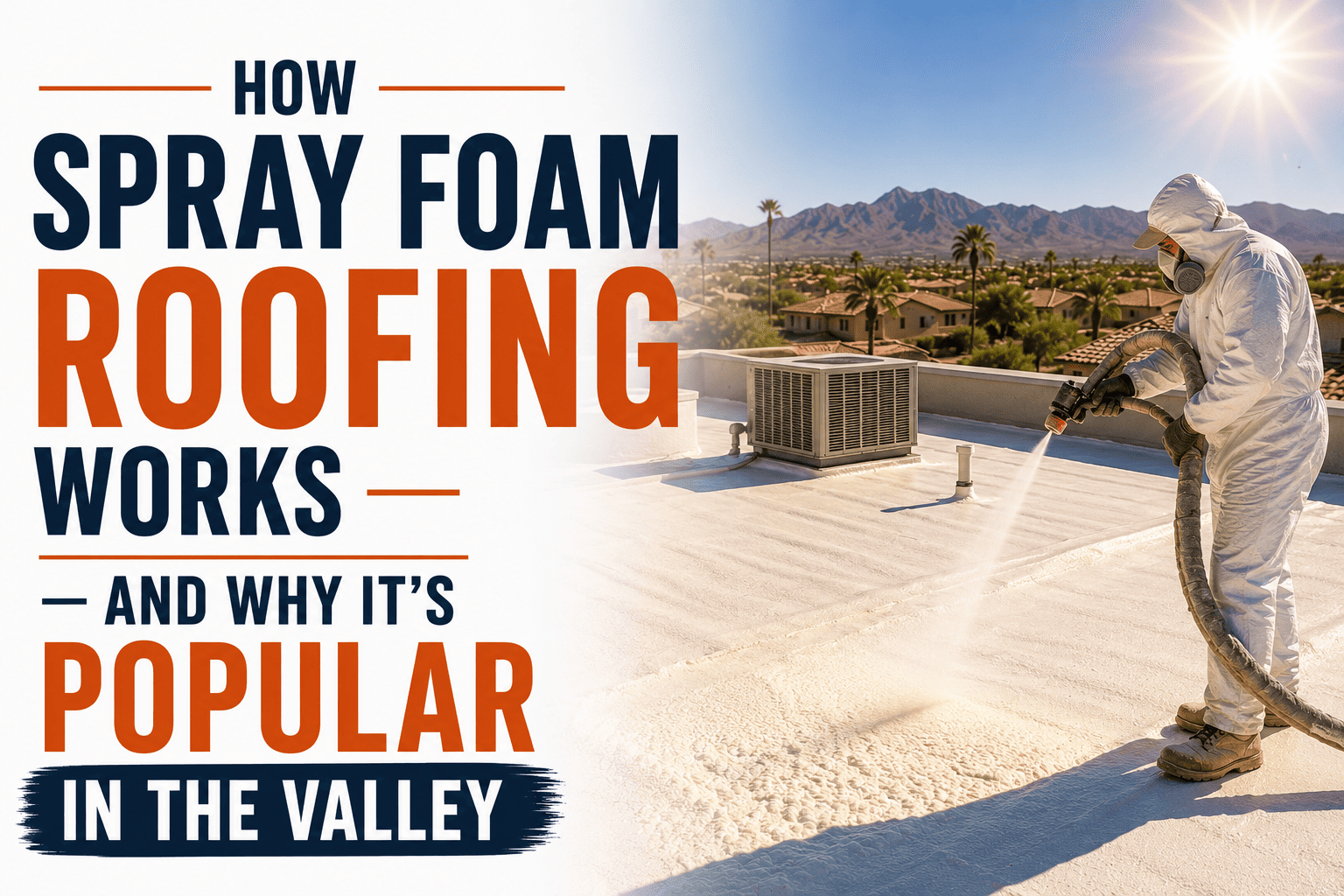
Spray foam roofing starts as two liquid chemical components that are mixed and sprayed together on-site. The moment they combine, they expand rapidly and cure into a solid, lightweight foam layer directly on top of the existing roof deck. Once the foam has cured, it’s covered with a protective elastomeric coating — usually white or light-colored — that shields the foam from UV exposure and adds waterproofing.
The result is a continuous, seamless membrane with no seams, fasteners, or joints for water to work its way through, which is a meaningful difference from roofing systems built out of individual shingles or tiles.
How the foam is applied
The process happens entirely on-site, in a few key steps:
- Roof preparation, including cleaning and repairing the existing surface
- Spraying the foam, applied in a controlled thickness across the entire roof area
- Trimming and shaping, so the foam creates proper drainage slope even on roofs that were previously flat
- Coating, applying the protective elastomeric top layer once the foam has cured
- Granule or additional coating passes, depending on the specific product and desired durability
Because the foam is sprayed as a liquid and expands into place, it self-flashes around vents, pipes, and edges — areas that are often the weakest points on other roofing systems.
Why spray foam performs well in Arizona’s climate
A few characteristics make SPF particularly well-suited to Phoenix-area conditions:
- High reflectivity. The white elastomeric coating reflects a significant amount of solar heat rather than absorbing it, which can meaningfully cool the roof surface compared to darker materials.
- Added insulation value. Unlike most roofing membranes, the foam layer itself provides real R-value, which can help reduce cooling costs in a climate where air conditioning is a major expense.
- Seamless waterproofing. With no seams or fasteners, there are fewer entry points for water — a real advantage during monsoon season when wind-driven rain tests every joint on a roof.
- Lightweight. SPF adds very little weight to a structure compared to tile, which matters for additions or older structures not built to support heavier materials.
Why it’s common on flat and low-slope sections specifically
Spray foam is generally used on flat or low-slope roof areas rather than the main pitched roof of a house. It’s a natural fit for these sections because it can be sprayed directly onto an existing flat roof, built up to create proper drainage slope, and sealed as one continuous surface — something that’s much harder to achieve with shingles or tile on a low-slope application. This is why you’ll often see SPF on patio covers, garage extensions, casitas, and additions even on homes where the main roof is tile.
What spray foam roofing requires for upkeep
SPF is a long-lasting system, but it isn’t maintenance-free. The elastomeric coating on top is what protects the foam from UV degradation, and that coating naturally wears down over years of Arizona sun exposure. Most spray foam roofs need a recoat on a regular cycle — the exact timing depends on the product and coating thickness — rather than a full tear-off and replacement. This recoat cycle is actually one of spray foam’s biggest advantages: instead of replacing the whole system, a fresh coating restores UV protection and extends the roof’s life at a fraction of replacement cost.
Where spray foam can go wrong
The performance of an SPF roof depends heavily on installation quality. Ponding water is the most common issue, and it usually traces back to insufficient slope built into the foam during application rather than a flaw in the material itself. Coating thickness matters too — a coating applied too thin will wear through faster and expose the foam underneath to UV damage sooner than expected. This is a system where installer experience matters as much as the product itself.
FAQs
How long does a spray foam roof last in Arizona?
With proper installation and regular recoating, spray foam roofing systems can last 20 years or longer, with the coating cycle extending the underlying foam’s usable life well beyond that of the coating alone.
Does spray foam work on a full pitched roof, or just flat sections?
It’s almost always used on flat or low-slope sections rather than a full pitched tile or shingle roof, since its main advantages — seamless waterproofing and custom drainage slope — are most valuable on roof types that don’t shed water on their own.
Is spray foam roofing more expensive than other options?
Upfront costs are comparable to other quality roofing systems, but the ability to recoat rather than fully replace often makes the long-term cost lower over the life of the roof.
Can spray foam be applied over an existing roof?
In many cases, yes — SPF can be sprayed directly over certain existing roofing surfaces after proper preparation, which can reduce both cost and disruption compared to a full tear-off.
Have more questions? Check out our FAQ page.