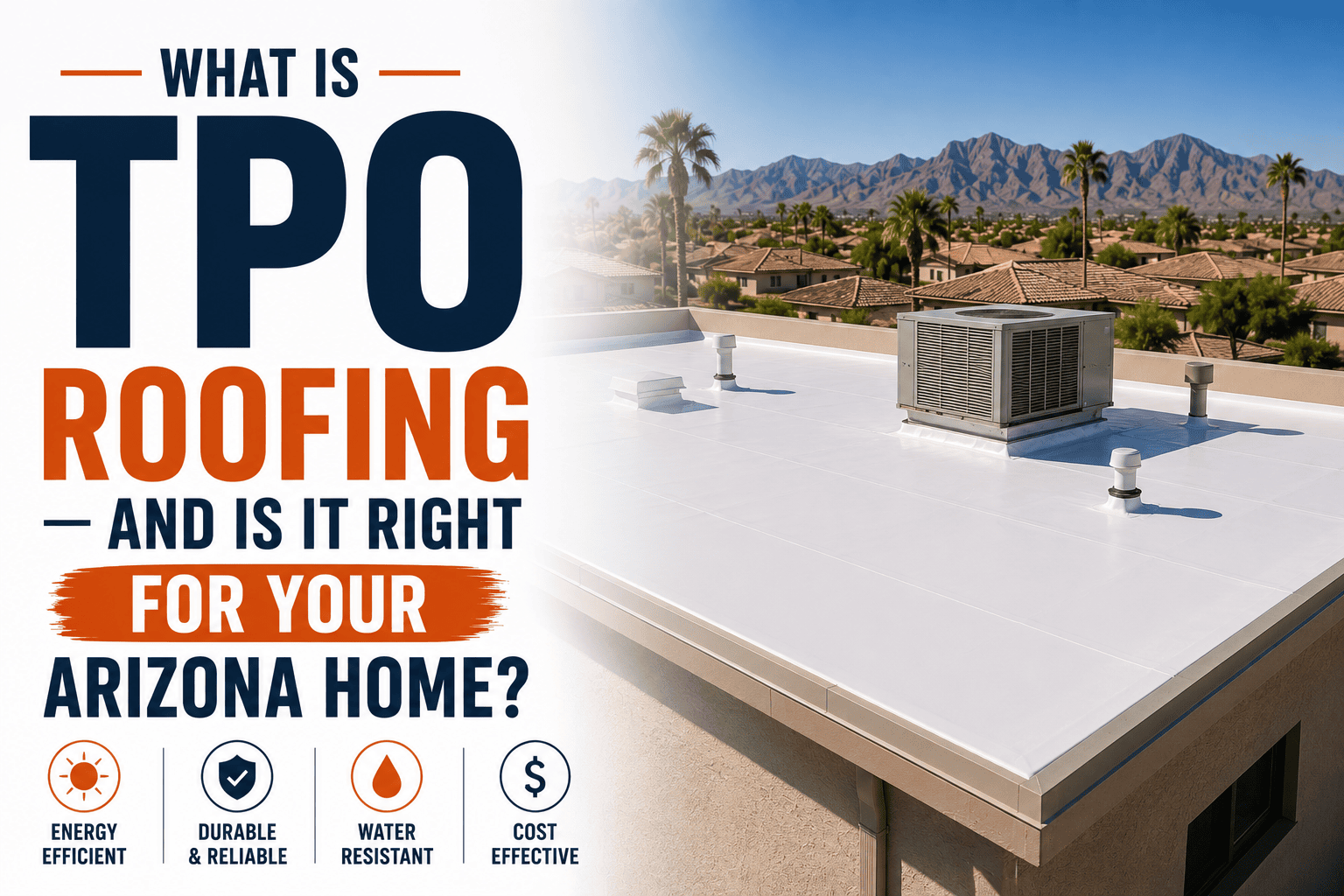
What Is TPO Roofing — and Is It Right for Your Arizona Building?
An honest look at TPO roofing — what it is, how it performs in Arizona heat, what it costs in 2026, and how it compares to other flat roof systems.
If you manage a commercial building, warehouse, or retail space with a flat or low-slope roof in the Phoenix area, there is a good chance you have already heard the term “TPO” from a contractor or seen it on a proposal. It is the most common single-ply membrane installed on flat roofs across the Valley today. But popular does not automatically mean it is the right system for your building. Here is a straightforward look at what TPO is, how it holds up under Arizona conditions, and where it does and does not make sense.
What TPO roofing actually is
TPO stands for thermoplastic polyolefin, a single-ply roofing membrane made from a blend of polypropylene and ethylene-propylene rubber. It comes in large rolls — typically 100 feet long — and is installed over insulation board, then heat-welded at the seams to create a continuous, watertight surface. Most TPO systems come in 45, 60, or 80 mil thicknesses, with thicker membranes generally holding up longer.
TPO can be installed three main ways: mechanically fastened with metal plates and screws, fully adhered with heat or adhesive, or ballasted with a layer of gravel to hold it in place. The right method depends on your building’s structure, roof access, and local wind requirements.
Why TPO is so common in Arizona
TPO’s biggest selling point in a climate like Phoenix’s is reflectivity. White TPO membrane reflects a large share of solar radiation instead of absorbing it, which keeps roof surface temperatures — and the building underneath — cooler. That translates directly into lower cooling loads during the months when air conditioning is running nearly nonstop, which is most of the year here.
TPO is also one of the more affordable single-ply options on the market, it is lightweight enough that a recover over an existing roof is often possible instead of a full tear-off, and it is flexible enough to handle a building’s normal expansion and contraction through Arizona’s dramatic day-to-night temperature swings.
Where TPO struggles in Arizona’s climate
The honest tradeoff is UV exposure. Phoenix gets more intense, sustained UV radiation than most of the country, and TPO membrane relies on antioxidants and UV stabilizers built into the material to resist breaking down. Those additives deplete over years of exposure, and as they do, the membrane can become more brittle and prone to cracking — particularly around seams and flashing points if the original installation was not done well.
TPO formulations also vary significantly by manufacturer. Because the material is still relatively young compared to systems like EPDM, quality and long-term performance are less consistent across brands, which makes contractor experience and product selection more important than with more established membranes.
TPO vs. other flat roofing systems
- TPO — roughly $4.50 to $12 per square foot installed. Best for cost-conscious buildings that want strong reflectivity and energy savings.
- PVC — generally costs more than TPO. Best for restaurants, food production, or facilities with grease or chemical exposure, thanks to better resistance.
- Silicone coating — roughly $2 to $7 per square foot. Best for extending the life of an existing roof that is still structurally sound rather than replacing it.
- Spray foam — roughly $3.50 to $8 per square foot. Best for buildings that want strong built-in insulation value from the roofing system itself.
- Built-up roofing — cost is comparable to TPO or PVC. Best for buildings that prioritize impact resistance over the lowest install cost.
Costs above reflect general 2026 Arizona market ranges. Your actual price depends on roof size, insulation needs, existing roof condition, access, and how much of the existing system can be reused versus torn off.
What drives TPO cost on your building
- Recover vs. tear-off. If your existing roof is dry and structurally sound, a code-compliant recover over the top is significantly cheaper than a full tear-off. Arizona building code generally allows a maximum of two roof systems on most buildings, so a recover may not be an option if the building has already had one done.
- Membrane thickness. 45 mil is the most economical option; 60 and 80 mil membranes cost more but generally offer better long-term durability under Arizona’s UV load.
- Insulation. Polyiso insulation boards under the membrane often cost as much as the TPO itself, and code-required R-values can affect how much is needed.
- Roof penetrations. Drains, curbs, skylights, and rooftop HVAC units each require additional flashing and detailing, which adds labor and material cost.
- Roof size. Smaller roofs generally cost more per square foot, since TPO comes in rolls and smaller spaces require more cutting and seaming per square foot of coverage.
Is TPO the right choice for your building?
TPO tends to make the most sense when reflectivity and upfront cost are the priority, and when the building does not deal with heavy grease, chemical exposure, or foot traffic that would favor a tougher membrane like PVC. It is also a reasonable choice when a recover over an existing roof is possible, since that keeps costs down and avoids disrupting operations with a full tear-off.
It is worth a second look — or a comparison against PVC, silicone coating, or spray foam — if your building has a history of ponding water, heavy rooftop equipment traffic, or exposure to oils and solvents that can degrade thermoplastic membranes faster than normal.
FAQs
How long does a TPO roof last in Arizona?
Most TPO systems are rated for 15 to 20 years, though actual lifespan in Arizona depends heavily on membrane thickness, installation quality, and how well UV exposure was accounted for in the product selection. Thicker membranes and quality seam welding tend to perform better long-term in the Valley’s heat.
Can TPO be installed over my existing roof?
In many cases, yes. TPO is lightweight enough that a code-compliant recover over a dry, structurally sound existing roof is often possible, which is significantly cheaper than a full tear-off. Arizona code typically caps buildings at two roof systems, so this depends on whether your roof has already had a prior recover.
Is TPO or PVC better for a commercial building in Arizona?
Both are single-ply membranes, but PVC generally costs more and holds up better against grease, chemicals, and heavy contaminants — which makes it a common choice for restaurants and food production facilities. TPO is typically the more cost-effective option for buildings without that kind of exposure.
How much does a TPO roof cost in Arizona?
TPO installations in the Phoenix metro generally run $4.50 to $12 per square foot installed in 2026, depending on membrane thickness, insulation needs, roof complexity, and whether the project is a recover or full tear-off.
What is the biggest downside of TPO roofing?
UV degradation over time is the main concern in Arizona’s climate. The additives that protect TPO membrane from UV breakdown deplete gradually, and once they do, the membrane can become brittle and more prone to cracking — which is why membrane quality and installation matter as much as the material itself.
Have more questions? Check out our FAQ page.